
employment-based Visas

Non-Immigrant Work Visas
Temporary work visas allow professionals, executives, and individuals with specialized skills to come to the United States for employment on a time-limited basis. These categories offer valuable opportunities for work, investment, performance, and company expansion, often serving as a stepping-stone toward future permanent residency.
L-1A / L-1B — Intracompany Transfers
L-1A: Managers and executives transferring from a foreign company to a U.S. branch, subsidiary, or affiliate.
L-1B: Employees with specialized knowledge.
Ideal for companies expanding into the U.S.
This visa is commonly used by executives, managers, project leaders, and professionals with specialized or proprietary knowledge—such as engineers, IT experts, and product specialists—who are being transferred to support or expand their company’s U.S. operations.
O-1 — Individuals With Extraordinary Ability
For professionals who have reached the top of their field in the arts, business, sciences, education, or athletics. Often used by founders, researchers, artists, and high-impact professionals.
H-1B — Specialty Occupation Professionals
For professionals working in roles that require a bachelor’s degree or higher, commonly used in tech, finance, engineering, healthcare, and consulting. The H-1B is subject to an annual government lottery, and candidates must be selected before they can file a petition for approval.
E-1 / E-2 — Treaty Traders and Treaty Investors
The E visa category allows nationals of treaty countries to work in the United States based on substantial trade or investment.
E-1 Treaty Trader: For individuals or companies conducting significant international trade between the U.S. and their home country.
E-2 Treaty Investor: For entrepreneurs and investors who make a substantial investment in a U.S. business and come to direct and develop the enterprise.
E visas are renewable indefinitely, as long as the qualifying trade or investment continues. They offer an excellent option for business owners, franchisees, and entrepreneurs seeking to operate or expand a company in the U.S.
P Visa — Artists, Athletes, and Entertainment Groups
The P visa category is designed for internationally recognized performers, competitive athletes, and essential support personnel.
P-1: For athletes or athletic teams with international recognition, and for entertainment groups with a sustained reputation.
P-2: For artists or entertainers participating in reciprocal cultural exchange programs.
P-3: For artists or entertainers coming to perform, teach, or coach under culturally unique programs.
The P visa provides a temporary but flexible option for professionals performing or competing in the United States, often covering tours, seasons, events, or extended engagements.
R-1 — Religious Workers
The R-1 visa allows ministers and religious workers to come to the United States temporarily to serve in a recognized non-profit religious organization. Eligible roles include ministers, missionaries, cantors, liturgical workers, religious instructors, and other positions dedicated to religious functions.
This category requires the sponsoring organization to meet specific criteria, and it offers a practical solution for churches, temples, synagogues, and other faith-based institutions needing qualified personnel for temporary service.
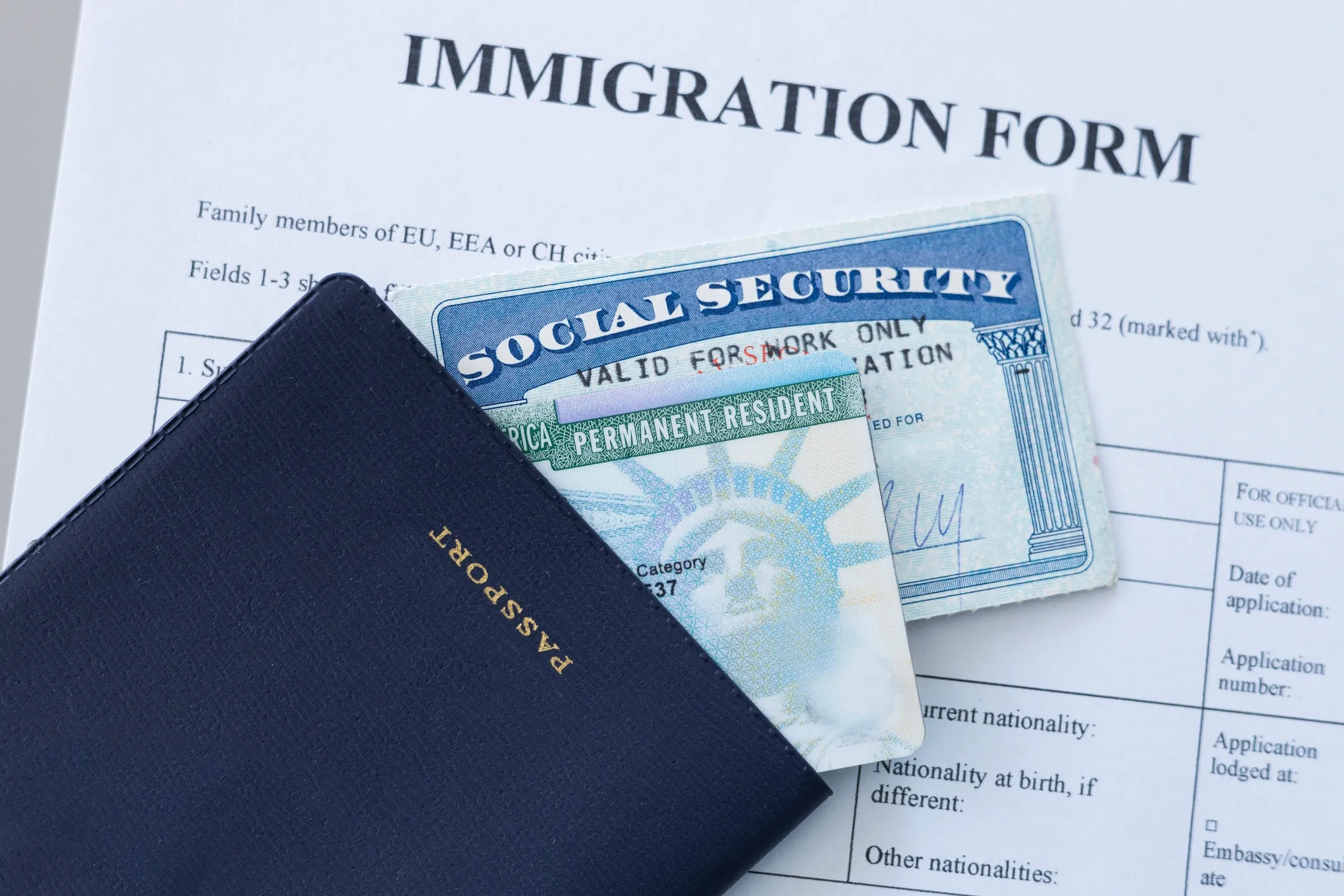
Immigrant Visas
Employment-based immigrant visas provide a direct pathway to a U.S. green card. These categories focus on your achievements, impact, and ability to contribute to the national interest or your field at a high level. They do not require employer sponsorship in all cases.
EB-1 — Priority Workers
The EB-1 category offers some of the fastest and most flexible paths to a U.S. green card, designed for top performers and multinational leaders:
EB-1A — Extraordinary Ability: For individuals with sustained national or international acclaim in fields such as business, science, arts, athletics, or education. No job offer or employer sponsorship required.
EB-1B — Outstanding Professors and Researchers: For accomplished academics with significant research contributions and a permanent job offer.
EB-1C — Multinational Executives and Managers: For senior executives or managers of multinational companies transferring to lead U.S. operations.
EB-2 — Professionals With Advanced Degrees or Exceptional Ability
The EB-2 category covers individuals who have an advanced degree or exceptional ability in their field, and typically requires a job offer unless applying under the NIW.
EB-2 NIW — National Interest Waiver
The NIW allows qualified applicants to self-petition for a green card when their work benefits the United States. Applicants can qualify under two NIW tracks:
Advanced Degree NIW: For professionals holding a master’s degree (or bachelor’s + 5 years of progressive experience) whose proposed endeavor is in the national interest.
Exceptional Ability NIW: For individuals with a high level of expertise in their field who meet at least three regulatory criteria and demonstrate substantial merit and national importance.
Because the NIW waives the job offer and PERM labor certification requirements, it is a strong option for entrepreneurs, researchers, innovators, healthcare professionals, executives, and specialists whose work advances U.S. priorities.
EB-3 — Skilled Workers, Professionals, and Other Workers
The EB-3 category offers a path to permanent residency for individuals with qualifying job offers in the United States:
Professionals: Positions requiring at least a bachelor’s degree.
Skilled Workers: Roles requiring at least two years of experience or training.
Other Workers: Certain positions requiring less than two years of training or experience.
This category requires employer sponsorship and the PERM labor certification process.
EB-4 — Special Immigrant Categories
The EB-4 category covers specific groups designated by U.S. immigration law, including:
Religious workers
Certain physicians
Broadcasters
Employees of international organizations
Special Immigrant Juveniles
Certain military personnel
Each subcategory has unique criteria, but all provide a pathway to a U.S. green card without the traditional employer-sponsored process.
family-based
Family-based immigration allows U.S. citizens and permanent residents to bring close relatives to live permanently in the United States. These cases are divided into two groups, depending on the type of family relationship.
Immediate Relatives of U.S. Citizens
This group includes the closest family members of U.S. citizens:
Husband or wife
Children under 21
Parents (if the U.S. citizen is 21 or older)
These cases are usually the fastest because there is no limit on how many green cards can be approved each year for immediate relatives. Once the relationship is proven and all requirements are met, the person can move forward toward a green card without waiting for a visa number to become available.
Family Preference Immigrants
This category is for other close family members of U.S. citizens or permanent residents (green card holders). These cases take longer because the government issues a limited number of visas each year. The groups include:
Unmarried sons and daughters (21 or older) of U.S. citizens
Spouses and children of green card holders
Unmarried adult children of green card holders
Married sons and daughters of U.S. citizens
Brothers and sisters of U.S. citizens
Each group has its own waiting time, which can range from a few years to more than a decade, depending on the family relationship and the applicant’s country of birth.

naturalization and citizenship
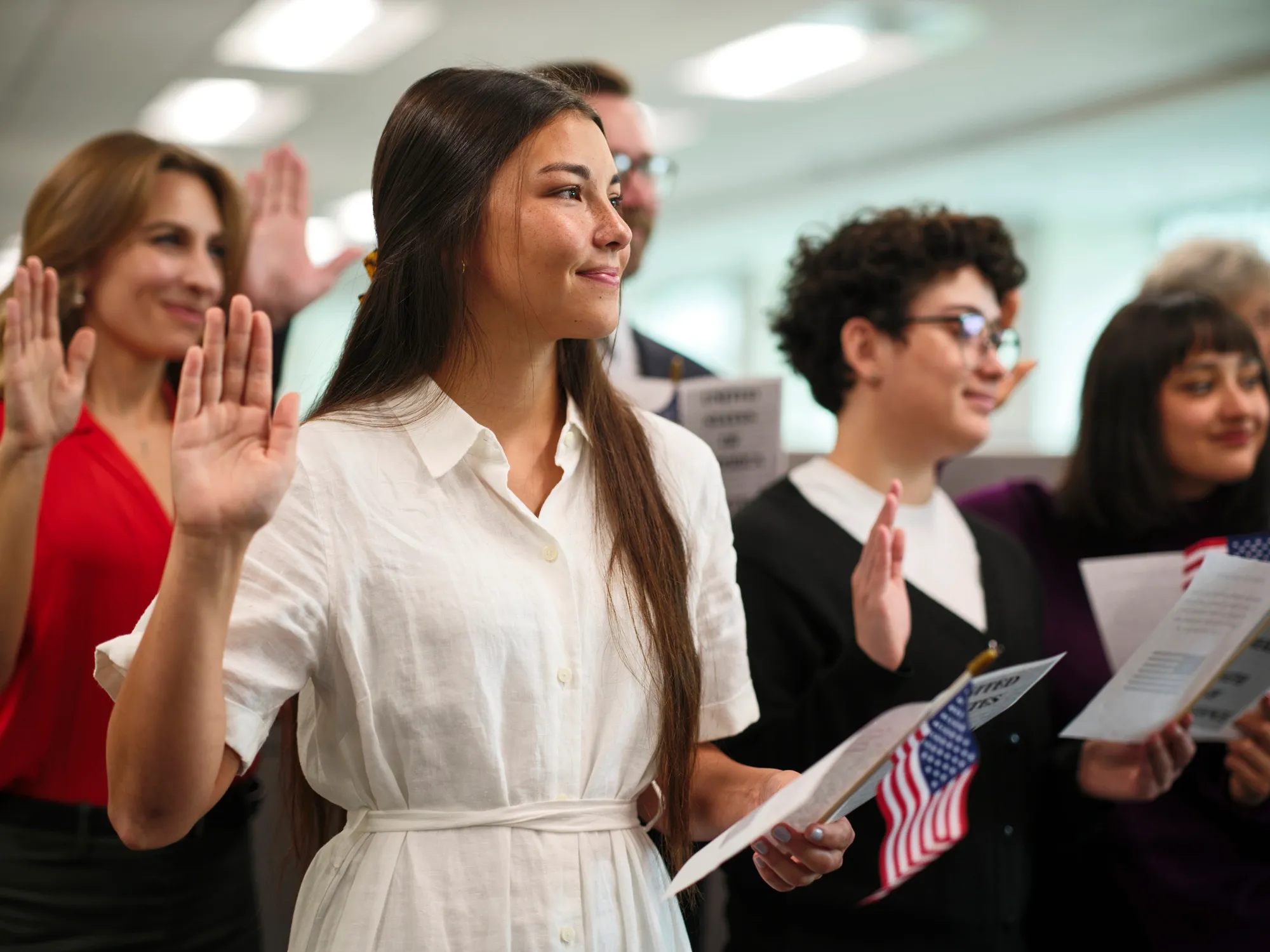
Naturalization is the process through which a lawful permanent resident becomes a U.S. citizen after meeting specific legal requirements. To qualify, applicants must generally be at least 18 years old, hold a valid green card, and meet the required period of permanent residency—5 years, or 3 years if married to and living with a U.S. citizen spouse. Applicants may file up to 90 days early before completing this residency period.
To be eligible, individuals must show continuous residence in the United States during the required period, with no absences of 6 months or more that could disrupt this requirement. They must also meet the physical presence rule by spending at least half of the required residency period physically inside the U.S., and must have lived for at least 3 months in the state or USCIS district where they apply.
During the naturalization process, applicants must demonstrate English language proficiency (speaking, reading, and writing) and pass a civics test covering U.S. history and government. They must also show good moral character, which includes complying with tax obligations, providing truthful information, and having no disqualifying criminal history. Other requirements include attachment to the principles of the U.S. Constitution and willingness to take the Oath of Allegiance, which finalizes citizenship.
Additionally, males aged 18–25 must have registered with the Selective Service System, or provide a valid explanation if they did not. Once naturalized, individuals gain the full rights and responsibilities of U.S. citizenship, including the ability to vote, obtain a U.S. passport, and petition certain family members for immigration benefits.